A stone breathes through its liberties
Count the empty points, connect a group, and discover how a small capture changes the board.
On this page
Start with an intersection
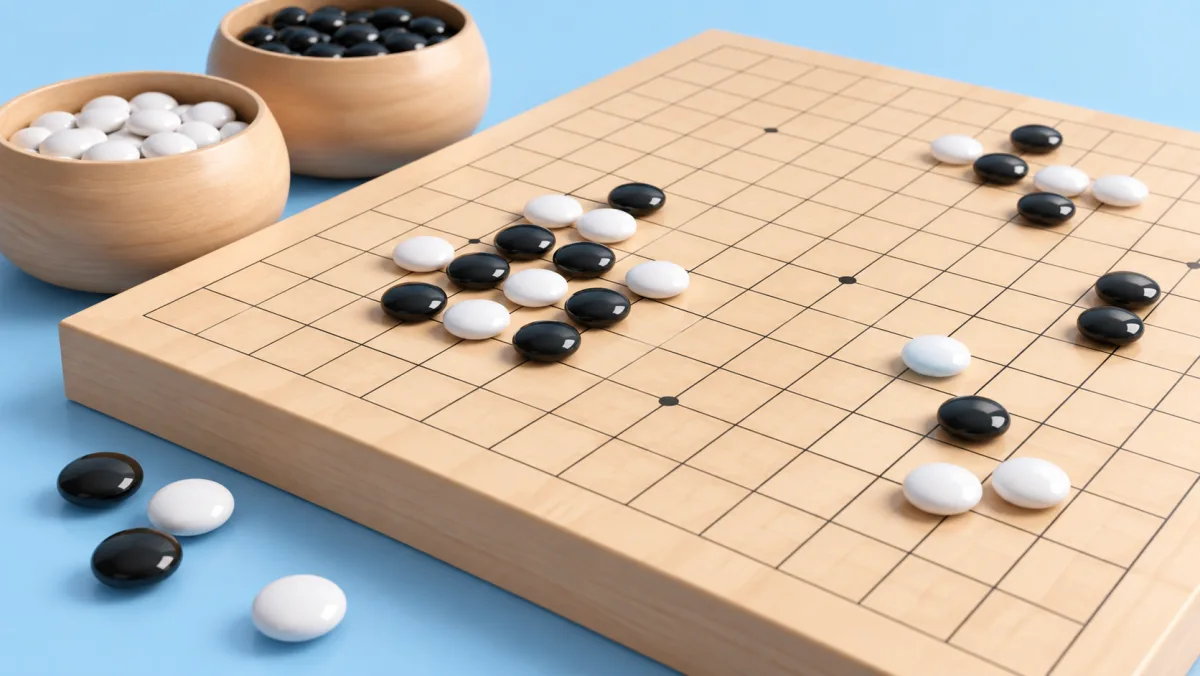
Go stones sit on intersections, not inside squares. A liberty is an empty orthogonally adjacent intersection. Diagonal contact is not a connection. Begin with our five-line teaching boards before trying a nine-line local game: fewer intersections make it easier to see cause and effect. The first exercise is small enough that you can count every neighboring point rather than rely on a visual impression.
Count the group, not the drawing
Place a white stone at C3. Black occupies C2, B3 and C4; D3 is the remaining liberty. Black at D3 removes the white stone. Now connect a second white stone at D3 in a different exercise. You must examine all the empty neighbors of both stones. A shared liberty counts once. Removing a group happens only after its final liberty is occupied, not when the picture merely resembles a circle.
Try the matching board lesson, then return to your reading.
Open the practice boardAfter two passes, count the board together
On this site, Go uses area counting with adjustable White komi, no suicide and positional superko for placements. Two consecutive passes begin review. Mark dead groups together, then count living stones and surrounded empty points; captured stones are not added again. If you disagree about a group, resume play from the board before dead stones were marked and settle the position by playing. The Playing rules page explains the scoring choices used by these boards.
Yao and Danzhu: a story passed down
One familiar legend tells of Emperor Yao devising Go to teach his son Danzhu. The story connects the black-and-white board with learning. At the board today, that learning begins with something you can see for yourself: a single empty point can keep a group alive, and a connecting move can change the fate of several stones. Try the two-stone capture lesson, then undo your move. Count the liberties again and notice exactly what changed.
A correction is welcome. Include the section and the source you would like us to check. Contact the editor ↗