Sudoku after singles: pairs and locked candidates, explained
Learn why candidate eliminations work, when a pair is valid and how a box can restrict a row. Includes counterexamples and a self-check.
On this page
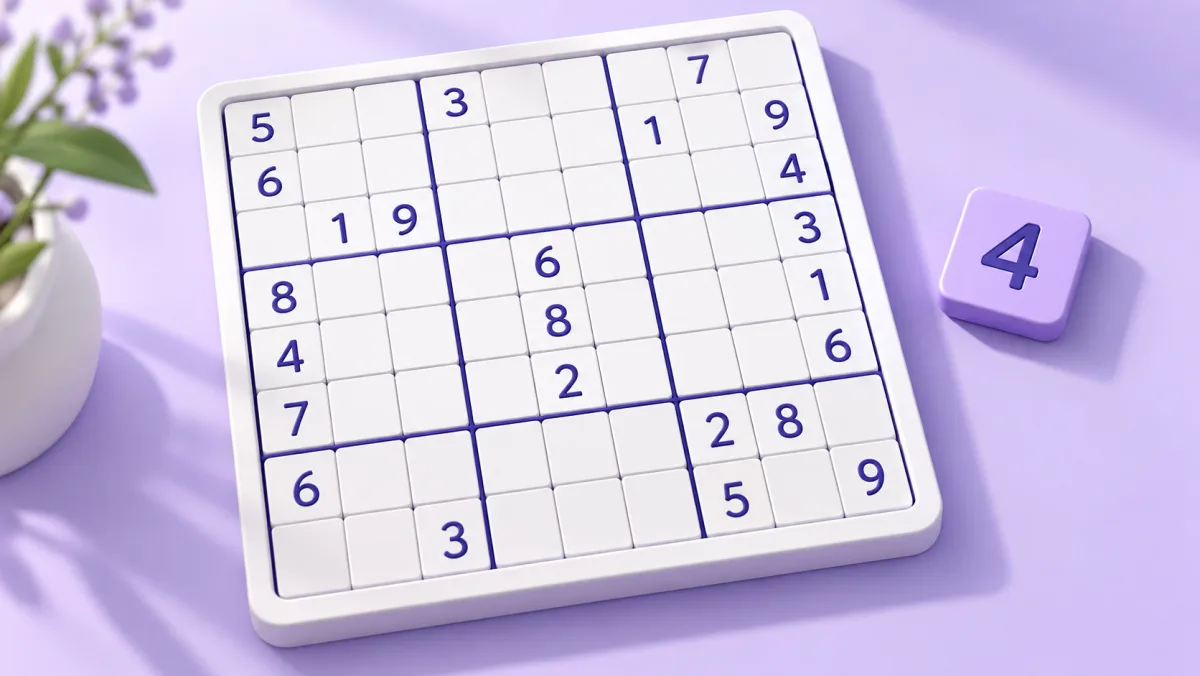
Candidates are possibilities, not hints from the answer
A standard Sudoku uses 1–9 once in each row, column and 3×3 box. The notation r2c4 means row 2, column 4. A cell’s initial candidates are the digits not already present in its row, column or box. A surviving candidate is possible under those constraints, not necessarily correct.
First check for mistaken entries. Missing a candidate can invalidate later reasoning. After a confirmed placement, update its peers rather than unrelated cells. The small candidate examples below demonstrate conditional local deductions; they are not complete, independently solvable puzzles. Use a full library grid for practice.
Two different ways to have only one choice
A naked single is a cell with only one candidate, such as {7}. A hidden single is a digit with only one available location in a unit. If row 6 still needs 7 and r6c8 is its only possible location, r6c8 must be 7 even if its notes also contain 2 and 9.
Ask both questions: “What can go in this cell?” and “Where can this digit go in this unit?” After every elimination, rescan singles before hunting for a harder pattern. If a missing digit has no available location, investigate earlier entries or notes; do not invent a placement.
Try the matching board lesson, then return to your reading.
Open the practice boardWhy a naked pair eliminates candidates
Suppose two cells in one row both have the complete candidate set {2,7}. They must take 2 and 7 in some order: neither digit may repeat in that row. Other cells in the row can therefore contain neither digit.
For example, if r4c2={2,7}, r4c8={2,7} and r4c5={2,7,9}, correct and complete notes allow r4c5 to become 9. You need not decide which pair member takes 2 first. The same argument works within a column or box, but only for cells sharing the unit that establishes the pair.
Three lookalikes that do not justify a pair
The sets {2,7} and {2,7,9} are not a naked pair: the second cell could take 9. Two {2,7} cells sharing no row, column or box do not form a pair either; there is no common unit supporting the elimination.
If three cells in one row all have complete candidates {2,7}, do not choose two and erase the third. Three cells cannot be filled by two non-repeating digits. Correct notes would reveal a contradiction in the current state. A matching pair of pencil marks is a reason to inspect the conditions, not automatic permission to delete candidates.
A box can lock a digit into one row
Suppose the top-left box still needs 5 and its only possible locations are r2c1 and r2c3. Both are in row 2. Whichever becomes 5, row 2 receives its 5 inside this box. Remove 5 from row 2 outside the box, for example from r2c5.
This pointing deduction does not choose between r2c1 and r2c3. It eliminates candidates elsewhere. Check every possible location in the box: an additional candidate at r3c2 would break the premise. “All possible locations lie in one row” is stronger than merely noticing two aligned candidates.
A row can lock a digit into one box
Reverse the direction. If row 5 needs 4 and its only possible locations are r5c4 and r5c6, its 4 must lie in the centre box. Remove 4 from other cells of that box outside row 5, such as r4c5. This is often called claiming.
Pointing starts with every candidate location in a box and eliminates outside that box along a line. Claiming starts with every location in a line and eliminates elsewhere in the box. State the premise in words before deleting. Then scan for singles; an elimination can be useful even when it does not immediately fill a cell.
A practical scan and review order
Start with entry errors and incomplete notes, then naked singles, hidden singles, pairs and box-line interactions. This is a convenient learning workflow, not a guarantee that these techniques solve every puzzle. Some grids require further methods.
Keep a short reason for each deletion, such as “r4c2 and r4c8 reserve 2/7, so remove them from r4c5.” If a contradiction appears, you can trace it. Use the answer to check a deduction you already made, not to supply a digit and invent a justification afterwards. Agreement with the answer is not itself a logical proof.
Practise one defensible deduction at a time
On a full library grid, first record all candidates for one row or box and check the restrictions you used. Next find a hidden single and explain why the other locations fail. Only then search for pairs or locked candidates, deleting nothing without a written reason.
If a pattern is absent, do not manufacture it. Try another grid or learn another technique. Review the first place you stalled: did you lack a method, or overlook a location while scanning? That distinction tells you whether to expand your toolkit or apply the existing one more carefully.
Pause and test your reasoning
In one row, A={3,8}, B={3,8}, C={3,6,8}. With complete, correct candidates, what fills C? What if B also contains 6?
Reveal the answer and reasoning
The pair reserves 3 and 8, so C is 6. If B also has 6, this naked-pair argument no longer applies; the stated information does not determine C.
Continue learning
A correction is welcome. Include the section and the source you would like us to check. Contact the editor ↗