Go life and death: True eyes, false eyes and the two-eye rule
Distinguish two secure eyes from two empty points, examine weak connections around an eye and calculate before deciding that a group is alive.
On this page
Two eyes require secure surrounding stones
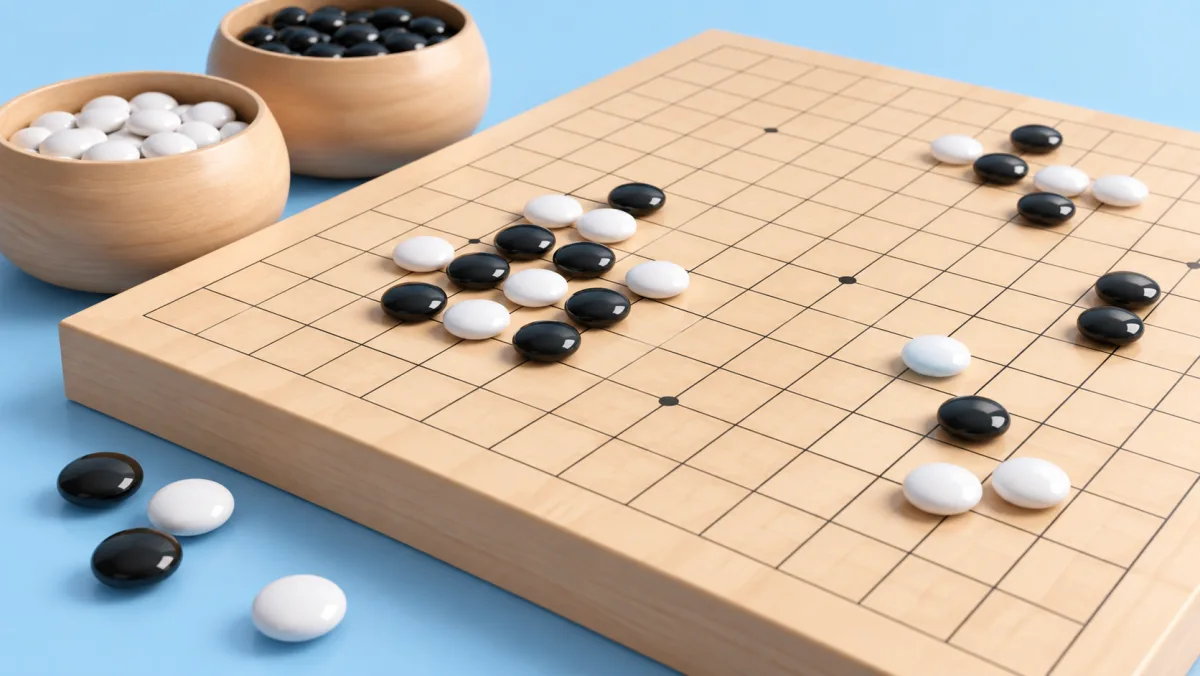
Find the entire connected group and ask whether its internal liberties can be filled. Two adjacent empty points may be one two-point eye space, not two separate eyes. Even separated empty points are insufficient if the enclosing stones can be captured independently.
For a securely connected group with two independent true eyes, under no-suicide rules, an opponent cannot fill both at once. Playing in one cannot capture the whole group while the other liberty remains, so the invading stone has no liberty. This explains two-eye life. Lacking two ordinary eyes does not automatically mean death: seki, outside connections and other variations require separate analysis.
Diagonals are a diagnostic, not a universal verdict
For common local single-point eye shapes, two enemy diagonals in the centre are a typical false-eye warning. On the edge or in the corner, even one enemy diagonal can undermine the eye; it is not enough to claim that controlling one of the two edge diagonals always secures it.
Control does not necessarily mean an existing friendly stone: legal access and subsequent captures matter. A diagonal count also does not prove that the surrounding group is already in atari; outside liberties and connections may exist. Trace the surrounding strings, include their outside liberties and test the opponent's cuts and captures before deciding that an eye is secure.
Try the matching board lesson, then return to your reading.
Open the practice boardA vital point is not tenuki
A vital point is a location that materially changes eye shape or connection. Tenuki means playing elsewhere instead of answering locally; it does not mean occupying a vital point.
In enclosed straight-three or bent-three eye spaces with stable boundaries, the central key point often determines whether two eyes can be made. Outside liberties, move order, ko and connections can affect the calculation. More space can offer more options, but there is no universal rule that six empty points automatically guarantee life. Compare the defender occupying the key point with the attacker occupying it first.
Verify a sequence rather than memorizing a shape name
List outside liberties and internal empty points, and establish which stones are actually connected. Test a possible eye-destroying move, removing captured enemy strings before checking the new friendly group's liberties. If outside liberties delay a capture, compare what happens when they are filled.
Distinguish unconditional two-eye life, a group needing the first move, ko or seki possibilities, and an analysis with unresolved branches. Branch from a reference position to test an alternative. A recorded line is not an exhaustive proof, and the site's scoring review requires agreed dead-group markings rather than automatic adjudication.
Pause and test your reasoning
Does tenuki mean occupying a vital point? Do two adjacent internal empty points automatically make two eyes?
Reveal the answer and reasoning
No to both. Tenuki means playing elsewhere. Two adjacent empty points may form one two-point eye space; examine separate eyes, surrounding connections and captures.
Continue learning
A correction is welcome. Include the section and the source you would like us to check. Contact the editor ↗