From Number Place to Sudoku
A short publishing history, followed by a practical way to read a grid without guessing.
On this page
A name with a publishing history
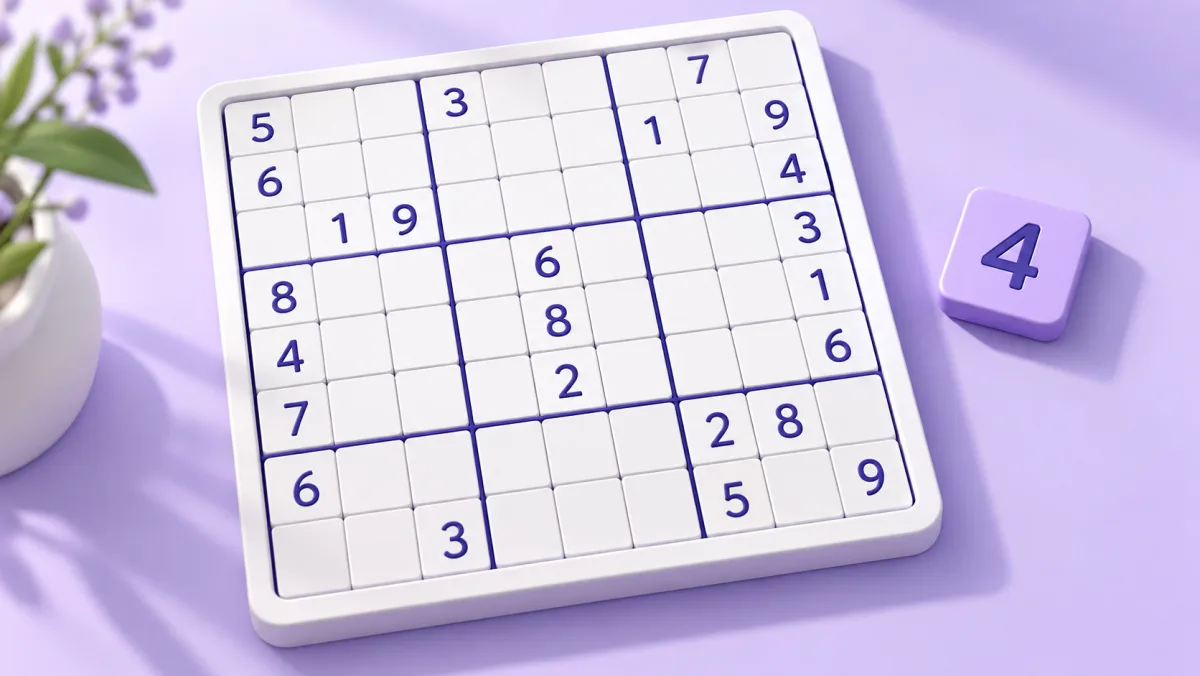
Nikoli encountered Number Place in an American puzzle magazine and introduced it to readers in Japan in 1984. Its longer Japanese title was shortened to Sudoku. In 1986, the publisher adopted symmetrical arrangements of clues. A grid may look very different depending on where its clues sit, but the three constraints stay the same: row, column and box. Start with those constraints, rather than the shape of the clues.
Numbers are labels, not sums
A Sudoku row does not ask you to add its entries. Each symbol must be used once under three intersecting constraints. In a mini grid, the symbols are 1–4 and the boxes are 2×2; in a classic grid, they are 1–9 and the boxes are 3×3. If you replaced every digit with a different letter consistently, the logical problem would be the same. Look for what is missing, not what adds up.
Try the matching board lesson, then return to your reading.
Open the practice boardWork one exclusion at a time
Imagine a 4×4 row containing 1, blank, 3, blank. The missing values are 2 and 4. If the column of the first blank already contains 2, that blank must be 4. Check its box before committing: if the box already contains 4, your earlier entries are inconsistent. This last check matters. A convincing row argument cannot override a conflicting column or box. Use Notes to record candidates, and Undo to recover a mistaken entry.
When you get stuck, make the hint useful
Choose one empty cell and write down the numbers missing from its row, column and box. Cross out any candidate ruled out by one of those three units. If only one remains, you have a reason to fill it. If several remain, leave a pencil note and inspect another cell. Try Hint after making that first pass. When it reveals a value, return to the grid and trace how that value affects its neighbors. Save the full answer for comparison after your attempt.
A correction is welcome. Include the section and the source you would like us to check. Contact the editor ↗