How to solve Sudoku: candidates, naked singles and hidden singles
Learn why a digit belongs in a cell, how two types of singles differ, and how to use answers without losing the reasoning.
On this page
Use constraints, not arithmetic
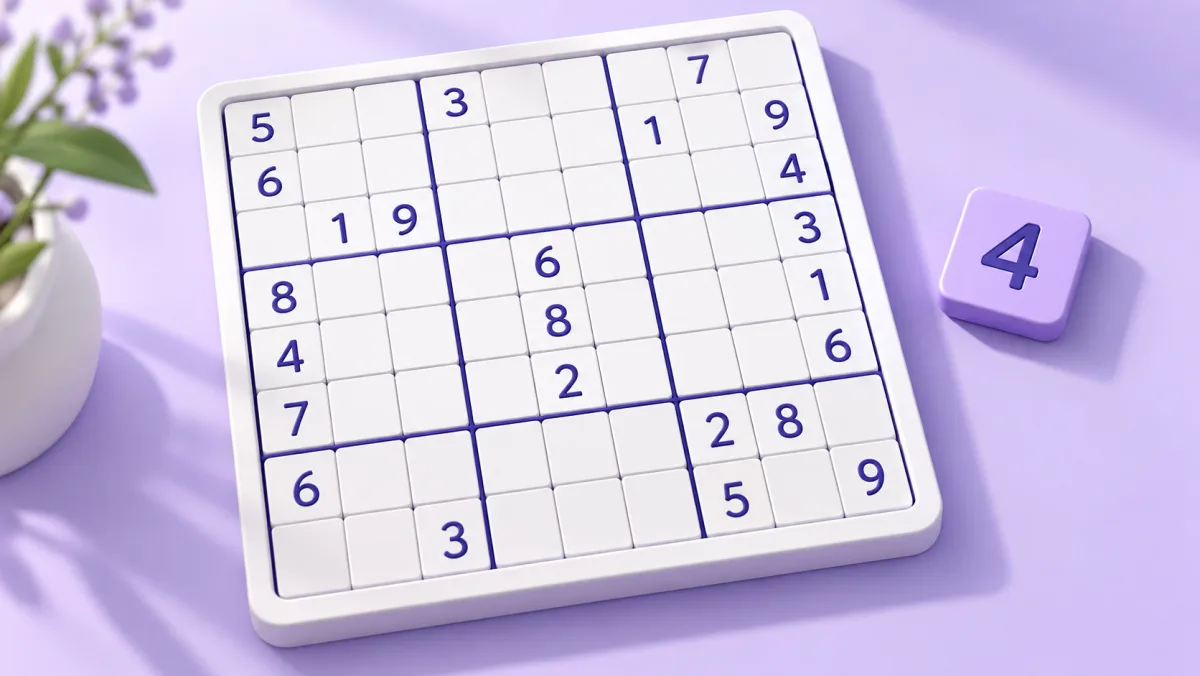
In a classic 9×9 Sudoku, each row, column and 3×3 box contains the digits 1–9 once each. Our 4×4 mini grids use 1–4 and 2×2 boxes. Digits are symbols here: adding the values is not how you decide the next move. Pick an empty cell and compare its row, column and box. Any digit already present in one of those three units is excluded. Write down all remaining candidates rather than choosing the digit that looks plausible. Fixed starting clues should not be changed to repair a contradiction.
A worked 4×4 naked single
Consider a 4×4 grid whose rows are “1 · · 4”, “3 4 1 2”, “2 1 4 3” and “4 3 2 1”, where dots are empty. In row 1 the missing digits are 2 and 3. Column 2 already contains 4, 1 and 3, so row 1 column 2 cannot be 3: its only candidate is 2. This is a naked single, because the cell itself has just one candidate after the three constraints are combined. Enter 2 and recompute, rather than treating old pencil notes as permanent. The remaining empty cell in row 1 is then 3. You can verify every row, column and box in the completed grid.
Try the matching board lesson, then return to your reading.
Open the practice boardHow is a hidden single different?
Now suppose the only candidates in three empty cells of a row are {2,5}, {2,7} and {2,7}, and that row is missing 2, 5 and 7. None of the cells is a naked single. However, 5 appears in only the first candidate set, so that cell must hold 5: a hidden single in the row. The word “hidden” refers to looking across a unit instead of at one cell. Use the same method in a column or box. This is a candidate-set illustration, not a separate published puzzle; apply it only after you have correctly computed candidates from the actual grid.
What should you do when stuck?
First check whether an earlier entry caused the problem. A duplicate in a row, column or box is a definite conflict, but the absence of duplicates does not prove every entry is correct. Undo the questionable move and refresh candidates. Next scan cells for naked singles, then units for hidden singles. If neither exists, do not claim that the puzzle has no solution: more techniques or a carefully justified branch may be needed. Our published grids have one verified solution. Use a hint to inspect a deduction, or compare the complete answer after your attempt. When you reveal an answer, return to one cell and explain which constraint supports it; copying every digit skips the most useful part of the exercise.
A correction is welcome. Include the section and the source you would like us to check. Contact the editor ↗