Xiangqi rules for beginners: horse, elephant and cannon
Learn three easily confused Chinese chess moves with coordinate examples, then test them in the interactive lessons.
On this page
What should you learn first?
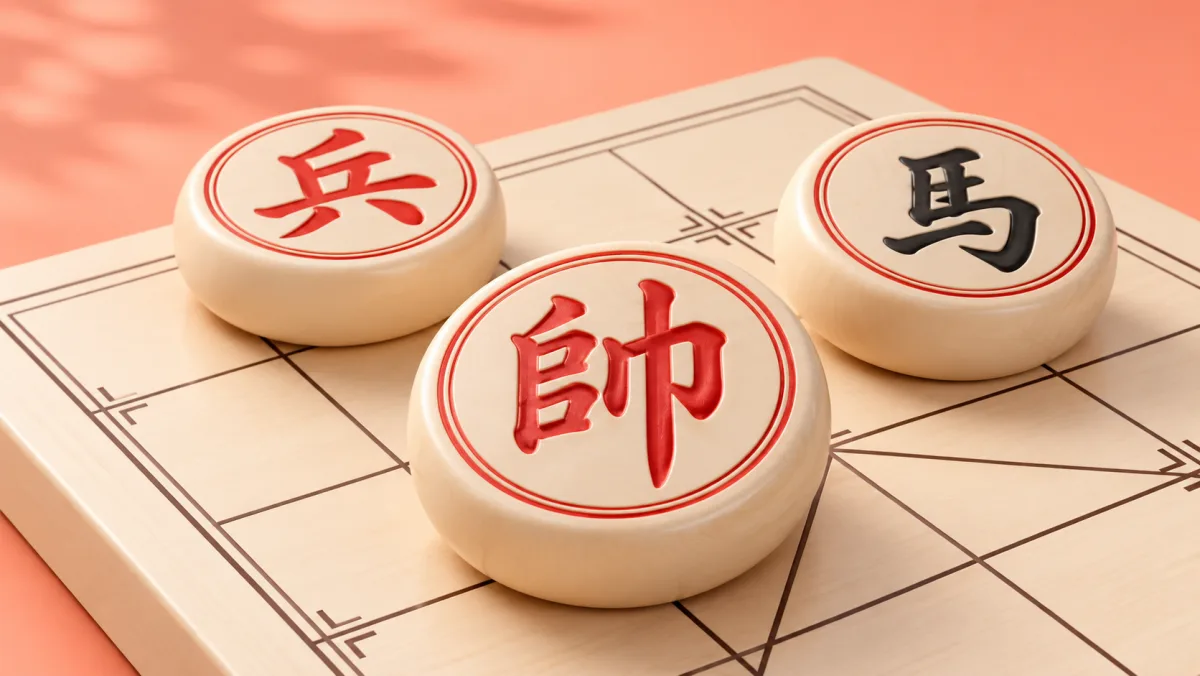
Start with the intersections: Xiangqi uses nine files and ten ranks. On our diagrams A–I run left to right and 1–10 run top to bottom, so E10 is at the bottom centre. Red moves first. Recognise the general, advisor, elephant, horse, chariot, cannon and soldier before trying a full game. The palace limits the general and advisors; the river changes the soldier’s movement and limits the elephant. Learning one piece at a time is more useful than memorising an opening sequence without knowing whether its moves are legal.
How does the horse move—and what blocks it?
The destination is two intersections along one axis and one along the other: an L-shaped displacement. A horse at E8 can reach F6 only if E7, its first straight step, is empty. For E8 to G7 the blocking point is F8 instead. A friendly or enemy piece on the blocking point prevents that direction. A piece on a different nearby point need not block the move. Try this checklist: identify the destination, identify the first straight step, inspect that step, then inspect the destination. A friendly piece at the destination also prevents the move. Finally check that moving the horse does not expose your own general.
Try the matching board lesson, then return to your reading.
Open the practice boardHow is the elephant different?
An elephant moves two intersections diagonally. In our bottom-side example, C10 to E8 requires the middle point D9 to be empty. That middle diagonal point is the elephant’s eye; either colour can block it. Unlike the horse, the blocking point lies diagonally from the starting point. The elephant also stays on its own side of the river. Compare two questions separately: is the eye open, and is the destination on the permitted half of the board? Removing an eye blocker does not remove the river restriction. The Chinese mnemonic “xiang zou tian” describes the two-by-two diagonal displacement, not a one-square bishop move.
Why does a cannon need a screen?
Suppose a cannon is at B8 and an enemy target is at B2. A capture requires exactly one intervening piece anywhere on B3–B7. Its colour does not matter. With no intervening piece, the cannon cannot capture that target; with two, it cannot capture it either. A non-capturing cannon move instead requires a clear path and an empty destination. On your next trial, move a screen away and compare the legal destinations before and after. Then ask whether a checking move actually leaves the general with no legal response. Checkmate and stalemate are losses in Xiangqi; our practice rooms use simplified repetition rules, explained on the Playing rules page.
A correction is welcome. Include the section and the source you would like us to check. Contact the editor ↗